What to expect in counseling
Great news! You’ve at least made it to a counselor’s website! Seeking out therapy can be a process, and it often brings a range of emotions. Whether you’re new to counseling or returning after a break, knowing what the next steps are can ease uncertainty and aide you in moving forward with greater confidence.
Here’s an overview of my general process, which is similar to what you’ll experience at most places, but we each have our own nuances.
Each therapist is is different (which is a good thing!)
There can be much variety in how clinicians (an umbrella term for counselors, therapists, and social workers) approach the process. Some are more structured with a set agenda for each session, homework, and sessions working towards a specific goal, in a specific time. Other therapists are oriented to be more open-ended or flexible, with sessions focusing on what feels most important in the moment, and may include an ongoing maintenance approach.
There’s not necessarily a right or wrong approach. There are times when specific modalities have greater evidence to support particular symptoms or a diagnosis. Working with a clinician, you get to try what feels most supportive to you for where you are right now. If you’re curious about my approach, visit my about me page.
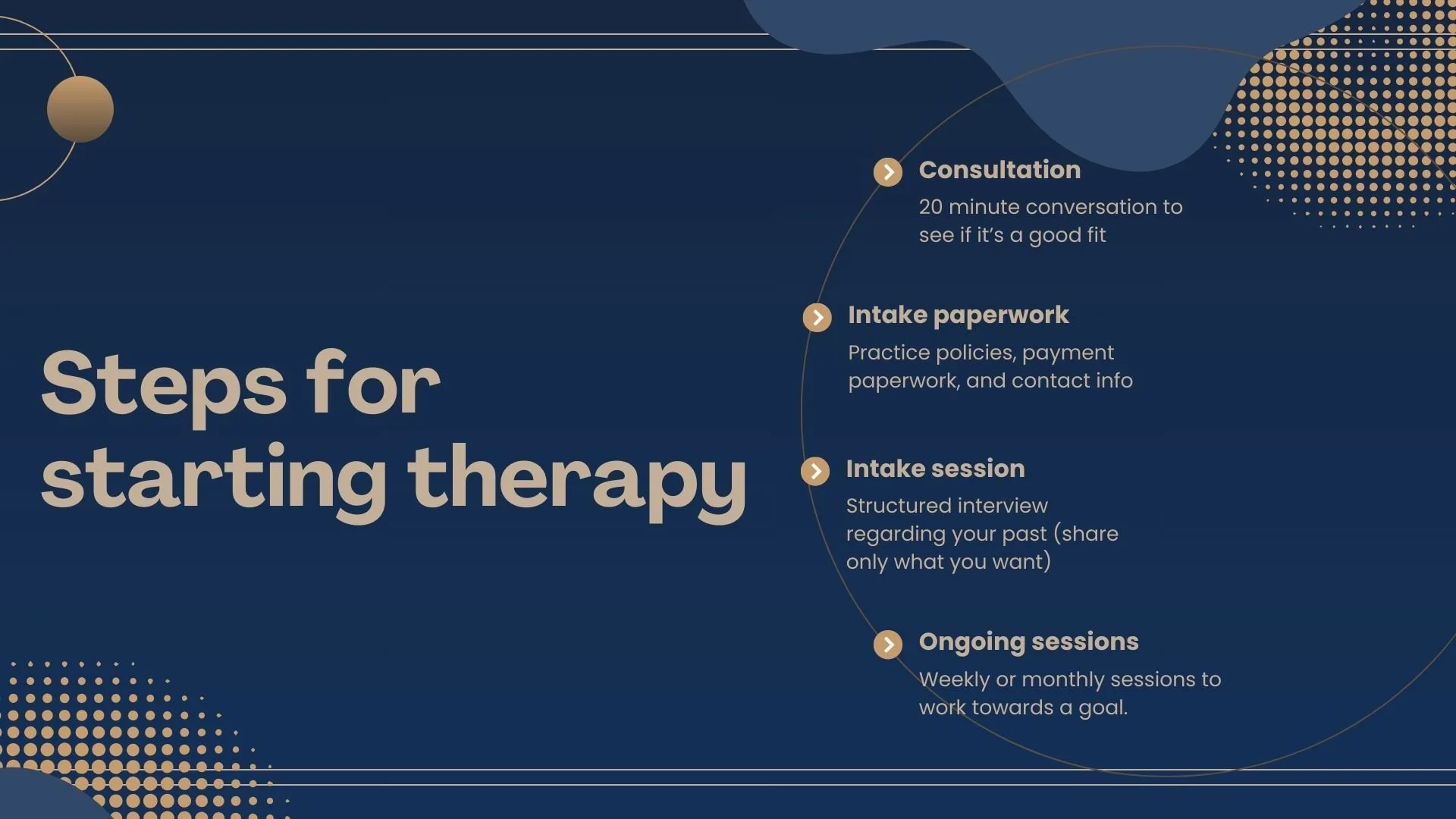
Steps for starting therapy
Step 1: Consultation
This brief video call occurs before you and the counselor (I’m credentialed as an LMHCA, so I’ll use counselor) decide to work together. You get to share what you’re looking for, and the clinician shares more about their approach.
The consultation an opportunity for you to gather more felt data if you connect with this person and want to share more about your life on an ongoing basis. You absolutely have a choice and autonomy in who you want to work with! I encourage you to reflect on if you feel safe, heard, and comfortable.
It’s also an opportunity for the clinician to assess if they likely have the experience to be supportive to you, or if there might be someone else better able to serve you. It's absolutely OK for it not to be a good fit for you, that’s not a judgement on you or your condition. It’s more a reflection that it’s not a good fit. Keep searching.
Step 2: Intake paperwork
This is usually the most cumbersome (and anxiety provoking) part of the therapy or counseling process. You’ll receive a link with forms to complete before the first session. This can include informed consent, a good faith estimate, telehealth consent, etc. Grab a glass of water, it can be anxiety provoking for some as it’s administrative. It is an importnat part of the process, as it outlines the expectations for therapy from the start.
There may also be a questionnaire for you to complete regarding your history and what you’d like to accomplish in therapy. You should share information about your history when and if you feel safe. There’s time.
Step 3: Intake session
Congrats! You’ve made it to the first session! This is often structured more as a guided conversation or interview. The intention is to build a shared foundation about you. If you completed a questionaire, it may parallel that structure.
Sometimes the intake can span more than one session, and again, you are in control of how much information you’d like to share at this time.
Some intake questions I ask are:
What brings you to therapy?
What are the most important aspects of your background or identity?
What’s a typical day like for you?
What is important for me to know about how you grew up?
What would you like to accomplish out of your time in therapy?
I recommend taking a little extra time after session to transition back into work or whatever else you have planned for the day. Grab an ice cream, go for a brief walk, look at some trees, whatever feels supportive to you.
Step 4: Ongoing sessions
These are typically 50-60 minutes, we know there will be talking, and we’ll be working towards therapeutic goals. How we approach this time can become much more of a choose your own adventure.
Dependent on the goals we set, sessions can be much more structured and focus on a specific area of your life. Sometimes it can be broader of what feels supportive to you, flowing between work, your past, relationships, and back to work. Homework can sometimes be assigned (your choice on doing it).
Progress isn’t always linear or packaged in a neat way. Although it could be interesting to earn adventure badges. Sometimes insights are developed in session and sometimes the after impact is layered and takes time to reveal itself.
Together we’ll talk about what feels supportive and where modifications can be made to best support you.
Closing thoughts
Starting therapy is a powerful action. You’re not expected to have the answers or be performative. Much of the experience is discovering, exploring, and healing at the pace which is right for you. Counselors take turns guiding and traveling alongside you in the process. And there are no wrong questions!
If you’re interested, contact me to schedule a free 20 minute consult to see what could be!