Why begin therapy?
People begin therapy for many reasons, and their journey with therapy can be unique and impactful in different ways. There are some general themes which tend to appear. I’ll share instances which lead to people seeking support from therapy, how therapy can be helpful, and why it can be beneficial to invest in therapy.
Why do people begin therapy?
People generally seek out therapy because they are experience some level of distress in their life. This could be distress or impairment in social situations, relationships, career, school, or other areas of life. The level of distress vary greatly, for some it’s noticing they which things could be better or is a preventive measure. Others arrive at therapy after something shakes them to their core. For some individuals, they are aware of the benefits of therapy and pursue it quickly. For others, it’s a journey which can include exhausting personal supports or pursuing self help strategies from social media, books, or podcasts.
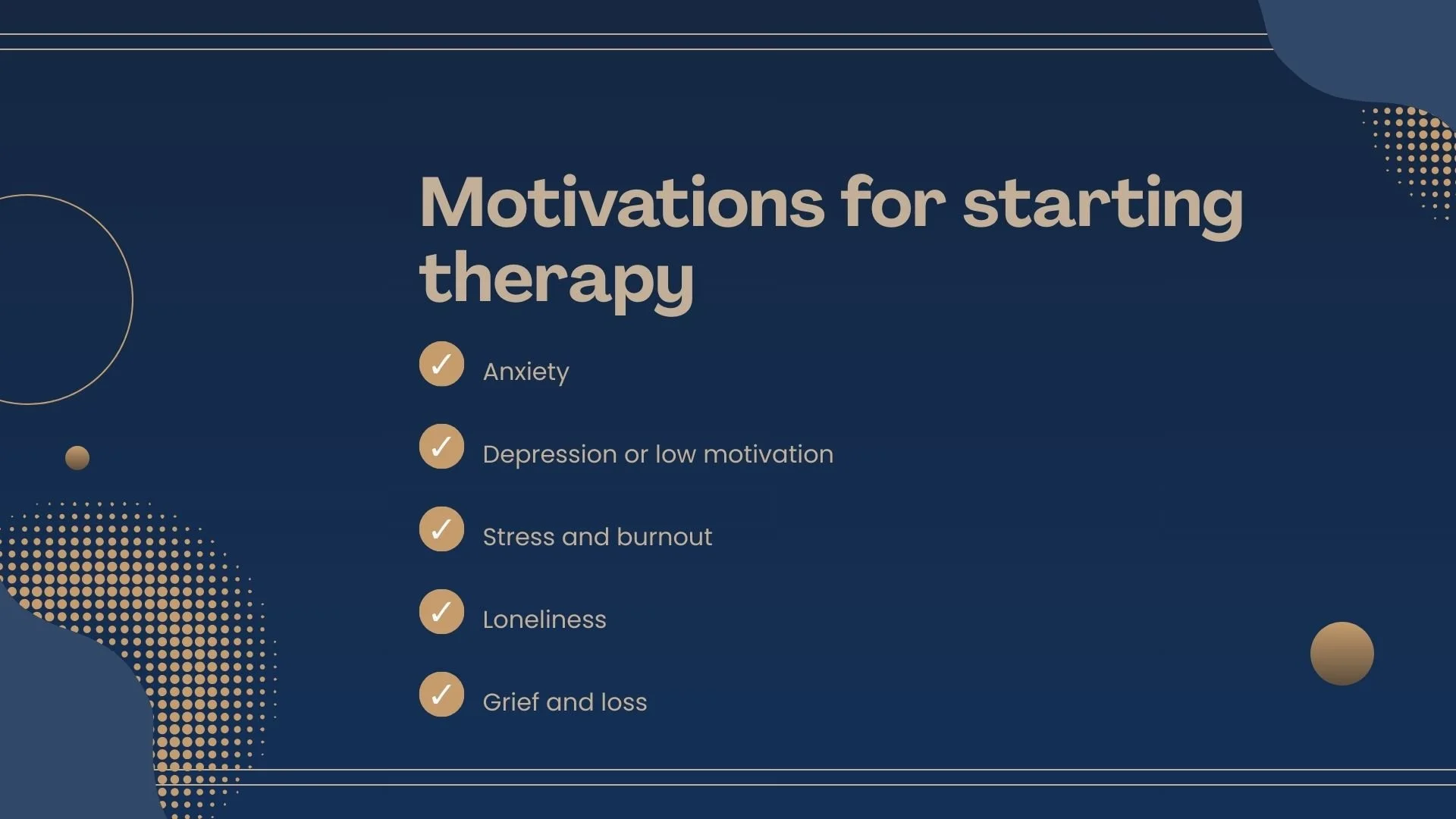
Motivations for starting therapy
It’s important to note these are self-described symptoms or life experiences. They are not all inclusive in describing the criteria for a diagnosis or a substitute to a diagnosis from a mental health professional.
Anxiety
Awareness of potential harmful outcomes can prevent injury, and that’s not a bad thing! Sometimes though anxious thoughts can become out of proportion and become difficult to control. Felt experiences related to anxiety can include restlessness, fatigue, difficulty concentrating, irritability, and reduced sleep quality sleep. Many people also find they are holding tension physically in their body in places like their jaw, elbows, or other joints. Other individuals seek support when they find themselves avoiding situations they may have previously enjoyed. Sometimes we find themselves over preparing for situations in an effort to prevent negative outcomes. The cost of this over preparation outweighs the outcomes, and again can be exhausting, as boundaries tend to slip.
Depression
There are may myths regarding depression, which can make it challenging to to find support or seek out treatment. One myth is you can suddenly snap out of depression if someone tries hard enough. That’s not true and increase stigma surrounding depression. Another myth is that depression is experienced as being sad. Often individuals describe their experience as a loss of contact with the range of emotions they previously had the capacity to feel. Life can feel flat or grey, with limited hope for seeing beyond the current experience. That hopeless feeling can be all consuming, and makes it even more critical to gain support around this medical condition, which could include crisis support from 988.
Life adjustments
People navigate adjustments successfully everyday, be it shifting from sitting to standing, walking to work, moving their household, and more. Life in many ways is a series of adjustments (yay and ugh). There are also transitions which can lead to uncertainty or even shake clients to their core. These transitional encounters can also unearth memories or feelings we didn’t realize need to address. This event can be a move, layoffs, a status change, or a change in relationship. Often the life event isn’t necessarily bad, but it requires building new skills and often a different perspective to deal with stressors.
Stress and burnout
Conversations regarding burnout are generally regarded as being tied to a professional capacity. Although this discredits caretaking and unpaid labor roles. Burnout leads to overwhelm, exhaustion, a shorter tolerance, and impacts sleep quality. As counselors we often conceptualize stress and burnout as a human response to inhumane expectations. It’s incredibly normal to have a reaction to distressing situations. Some clients, they have the option to remove themselves from a situation leading to burnout. For others, that’s not an option. Either way, it’s important to disrupt patterns which contributed to burnout and build supports and healthy habits to counter stress and burnout. Stress can be constant, and there are strategies to help navigate stress.
Loneliness
Earlier this year the loneliness epidemic entered the news cycle. Loneliness is a deep longing for connection and community. It can be difficult to reach out and make vulnerable asks to others. Especially for those who are new to the city or have made a recent adjustment. It can be isolating to not have others to spend time with or feel “unseen” by people around you. It can be difficult to know where to start and internal critical energy can make it more difficult to venture out or feel safe.
Grief and loss
Unfortunately part of living is to experience loss. This loss could include a loved one or be classified as ambiguous loss. This loss isn’t tied to the death of an individual and there is an absence of closure. Any kind of grief can bring about existential questions and there is no one way to experience grief. Clients often describe being disoriented and feeling like will never be the same. Like with loneliness, there can be an acute pain with being around people who continue going about their day, unaware of the agony or shattering of your reality.
What are the benefits of counseling?
Just like how there are many sources of distress which lead people to seek out therapy, there are many reported benefits for therapy.
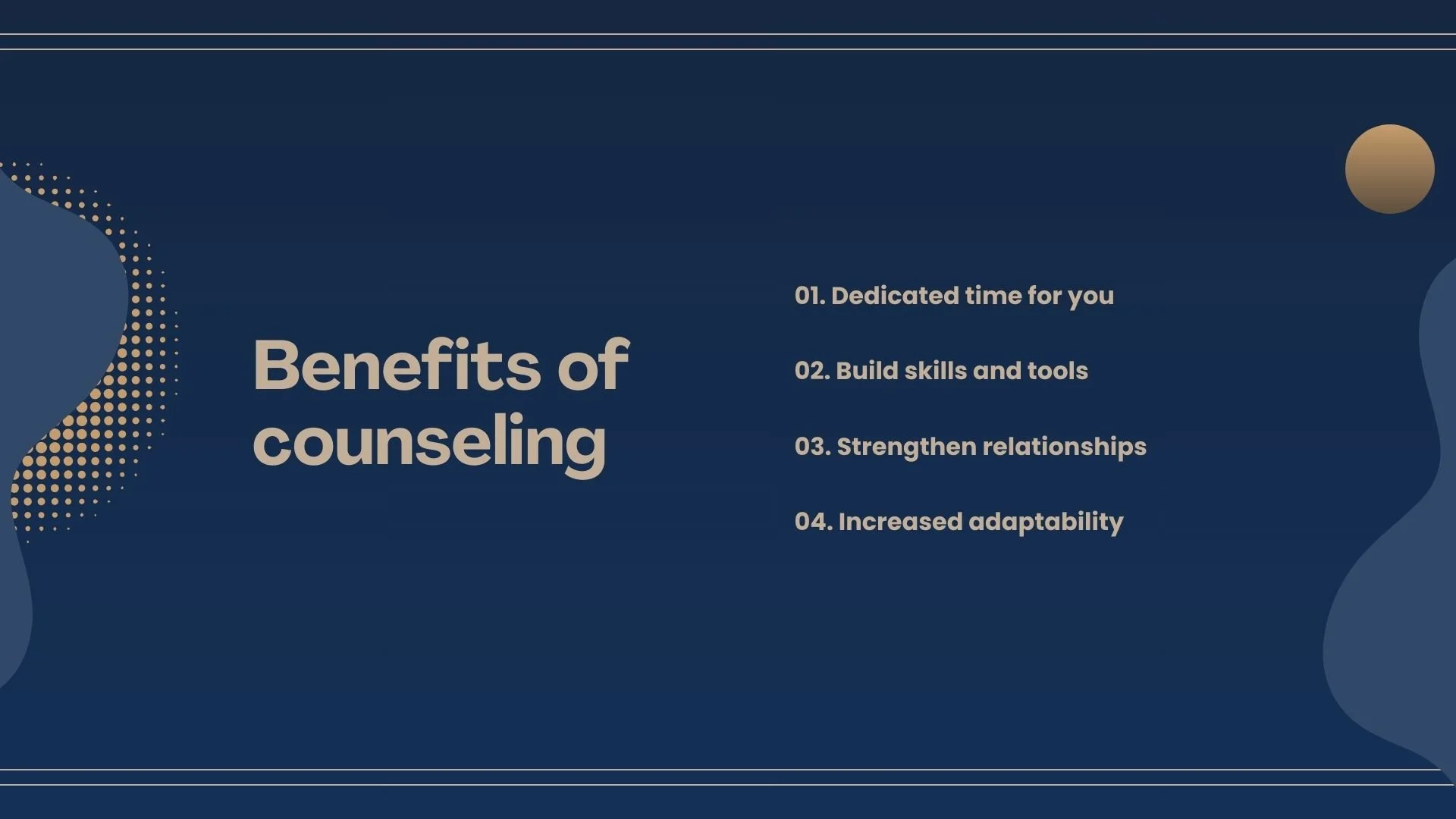
Benefits of counseling
Dedicated time for you
The 50 minutes or so each week is protected and dedicated time for someone to focus on themself. It is a protected and dedicated space they can count on, and what happens in session often carries over for the rest of their week. Unlike spending time with a friend or family member, counseling time is structured to be focused on you. Unlike a traditional give and take relationship with a friend or family member. As a counselor, I have supervision, my own therapy, and consultation spaces to support my needs, and time in session is focused on the client.
It is time where someone can as freely as they would like share their thoughts, feelings, and emotions. Together with their counselor they can reflect and explore what is happening. This can lead to clarity around goals, patterns, values, and more to help move forward with more informed choices. It is also worth noting it might not be what we want to hear in the moment, but there is space to explore that as well.
Build skills and tools
As someone who uses Cognitive Behavioral Therapy techniques, I see the importance of education and awareness surrounding unhelpful thoughts. CBT has a sort of greatest hits related to unhelpful thoughts, which when identified, can provide clues that critical or anxious energy may be influencing what we take to be true. Once these patterns like, relying on should statements, jumping to conclusions, or disqualifying positives, are identified there’s an opportunity to step back and re evaluate the conclusions a client arrived at and are unhelpful.
A oversimplified example would be thinking, “I really messed up that interaction at work. I therefore am a mess and horrible.” That was quite a leap from what I did to who I am. Let’s try it as “I really messed up that interaction at work.” PERIOD. What would be helpful for me to do now? Get a snack before I go into my next meeting, because I realize my blood sugar dropped. This allows us to continue on and not sabotage or ruminate in something which probably isn’t true.
Another skillset therapy can be supportive with is mindfulness or grounding techniques to slow and keep your mind in the present moment. By staying in the present and not getting “hijacked” individuals are able to respond and be in control of their actions, and not reacting or lashing out.
Grounding techniques can also be calming and occupy space in your brain that might wander to somewhere more anxious or unhelpful. There can be other areas of life, like communication skills, boundary setting, or somatic awareness which we find helpful learning about and practicing in therapy. Often they haven’t had a chance to practice or learn additional methods, and practicing in a contained space can build confidence and benefit their broader life.
Strengthen relationships
There is couples and family specific therapy, which impacts the overall dynamic of a respective group. Also many find individual therapy helpful for showing up better in their various relationships. Therapy provides a space to explore your own communication styles and what from their past may be informing the conflict they are experiencing. How humans relate to others is shaped at an early age, and can be carried through in ways unrealized. This is fundamental to attachment based therapeutic theories.
Increase adaptability
Therapy isn’t always about striving or growth. There are also moments to pause and reflect the resilience and grit which has led to where someone is now. It’s important to acknowledge the efforts and situations someone travels through. There is an emphasis on being strengths based and adapting those strengths in different ways to continue to survive and thrive.
Life often demands we adapt to circumstances, and it can be therapeutic to pause and take authorship of the meaning someone make to circumstances. This is where people often have the most agency, and it can also need the most care.
How do you justify the cost of therapy?
Attending therapy or counseling is an expense (or investment) in both time and money. It takes time to attend a session, and if it’s not virtual, clients need to account for travel time. Many choose to frame this time cost as a maintenance cost like going to the gym or workout class. From a financial standpoint, clients can opt to use providers in their insurance network, many though find they are able to have greater choice and reduce costs by using out of network benefits, and there are reduced fee options, like Open Path Collective.
It is not affordable or attainable for all, which I want to acknowledge. Also, as a counselor, I do present a biased opinion, and here are a few other ways people describe how they approach the time and financial costs of therapy.
-
Just like how physical health impacts how someone shows up in their life, mental health also has an impact. If you break a tooth, it’s not just eating which will be impacted. How you communicate, your tolerance around others, and general functioning will be impacted and noticeable. That deserves care and a trip to the dentist.
If you’ll humor me for another physical comparison, elite athletes don’t get a pass to not attend practice, do conditioning, or meet with their coaches for feedback. In many respects training and the support systems get greater at an elite level. Mental endurance is no different.
-
By addressing issues before they become larger, it can help make coping and recovery easier. People often find they are able to incrementally address stress and avoid less positive outcomes.
For those who are working to address avoiding situations which used to bring them joy, with therapy, they gain additional skills to safely integrate in avoided activities or situations. Life can become less insular, and sometimes that requires jumpstart support from a professional.
-
Some therapeutic goals are tied directly to spending habits and the relationship people develop regarding money throughout their life. By addressing challenges in therapy and exploring alternative coping habits this can curb and redirect funds tied to consumerism to solve problems. Don’t get me wrong, I do love a “treat yourself” moment, but there can a time when stops providing the positive benefits and becomes hallow. We want to protect the real and authentic “treat yourself” moments.
The exploration people do in therapy can also lead to making lifestyle or career changes. Knowing these changes are rooted in values and goals can build confidence and lead to greater financial options or contentment in the long run. This is also where rage quitting your job and immediately losing health insurance benefits generally becomes much more expensive than trying out therapy while you work on an exit strategy.
A final note
Thank you for reading my reflections and musings on when and how therapy can be helpful, as well as considering common financial considerations have when deciding to make an investment in time and money. I hope you find the mental health support you need. If you’re interested my counseling services, I can be contacted by email. Google and Psychology Today are great search options, and Open Path Collective exclusively lists providers who have flexibility in their pricing based on income and current insurance status (I’m also on this site).