Mental pitfalls for entrepreneurs
Key points: There are unique all or nothing stressors entrepreneurs face without experiencing a reprieve. To sustain their focus and health throughout the critical periods, there are four key areas of mental health they must be prepared to address: fear of failure, loneliness, avoiding work-life balance, and decision paralysis.
In my counseling practice I often work with clients struggling with how their professional responsibilities compete with the life they want to live and value. There is a unique situation for entrepreneurs who feel different challenges then clients working within an established organization. They know all to well the weight of having their and and others livelihood in their hands. I am passionate about this work, and it can include working with other small business owners. Everyone’s experience is unique, and here are a few common mental health themes which tend to appear for entrepreneurs.
As I also disclose with my clients, my counseling practice is a small business, which I own. I feel the unique challenges of feeling the full weight on my shoulders. I wouldn’t take back my choices, but it is a unique experience of being an entrepreneur. I also see my own therapist as part of my own mental health care.
Fear of failure
There are sobering stats, like from Nevada’s Public Radio, that almost one in four small businesses will fail in their first year. Stats like these provide evidence for fear and anxiety in entrepreneurs which often lead to throwing yourself headfirst into work and letting almost everything else fall to the wayside as evidence of your dedication. Fellow entrepreneurs tend to be hyper aware of the time, money, and cost to relationships they have invested in hopes of a return. It is very personal, even with the best of boundaries, to manage your business. Because it is your business, and not someone else’s which you can give two weeks notice and walk away from.
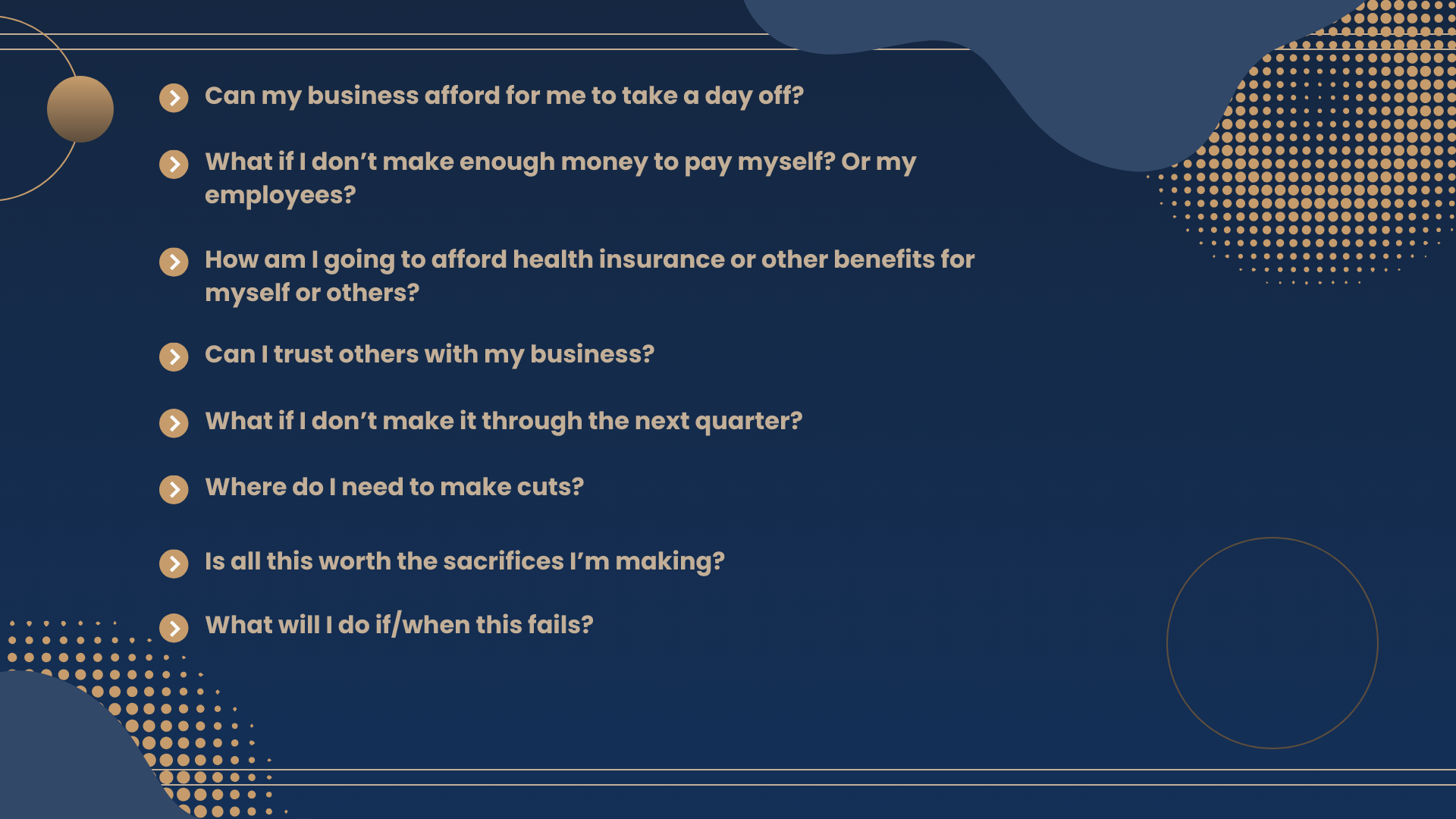
Common fears for entrepreneurs
Fear and anxiety
As a counselor, we often discuss how fear and its cousin anxiety aren’t always negative. Fear prevented our ancestors from taking unnecessary risks and kept them alive. But sometimes the feeling of fear or anxiety be hijacked or have the volume turned up beyond the potential threat. This is where Cognitive Behavioral Therapy (CBT) can be helpful in parsing out anxious or fearful emotions from the facts of a situation.
Some clients also find themselves in a freeze response when fear becomes overwhelming. They will avoid actioning on priority tasks and see distracted when faced with fear. It can be confusing to those around them, because for these entrepreneurs they are taking comfort in details they feel they can control, but as the leader of the company, the success of the business often hinges on their ability to return to the priority tasks, especially when it comes to financial decisions.
Strategies for fear of failure
In my own work, I’ve found it helpful to heed advice of others to broaden my view of success. Yes, like all businesses, I measure profits and margins. I also have contributing goals which I measure monthly and take time to acknowledge progress there. These additional examples of my successful milestones remind myself that I am building a foundation and growing my business in multiple areas.
To also acknowledge progress against goals and building confidence entrepreneurs can also review monthly or quarterly progress in the various areas they are concerned with. Be it billable tasks or non-billable. Filing taxes, returning leads, networking, etc. are all contributing actions to the growth of an entrepreneurs skillset and business. Step by step, it all counts towards building healthy habits and a more sustaining business (and life).
In addition to broadening the definition of success and acknowledging progress, many find it helpful to integrate practices of hope and inspiration. This could come from within the business or pursing practice outside the business, but they find it helpful to pursue future looking activities to contribute to a vision of hope and growth, instead of feeling things get smaller or stagnate.
Loneliness
If you’ve worked in a larger company, you’re aware of the support system you can tap into. Let’s be honest, sometimes it’s too many people and instances where, “this meeting could have been an email.” There are people above, below, and at the same experience level. As an entrepreneur or small business owner it’s much smaller and individuals play many roles.
Comparative cautions
If you find your circle of fellow entrepreneurs small, it can be tempting to seek company from people without this lived experience. Similar to if you’re a new parent, and you seek advice from all your best non parent friends. They may have great advice, but you are unlikely to find the empathy lived pain of what it’s like and be seen. I’ve heard from other entrepreneurs and clients that attempts to seek validation can quickly turn to comforting or focusing on the other person imagining their unattempted career goals. Sure, it’s a form of connection, but it’s not the validation and empathy the entrepreneur desperately needed in the moment.
It can also be less helpful when trying to compare your success against someone else in a different situation. Often in the early years, growth is much slower for entrepreneurs as they build their foundation and client base, so it can be grim to compare against a peer entering into an established company. That will change eventually, and there are other pros and cons along the different trajectories. There are so many options for how to make money or conduct business. What we want to avoid is situations which promote shame and self attacks by comparing apples and oranges.
Community building
Often the tension turns internal and to a critical energy, because there’s no one else to deflect blame towards. Responsibility is high and it is on a single individual to source supporting community outside the company. I know many freelance creatives who have found mastermind groups or community gatherings like Creative Mornings helpful in finding inspiration and community. Because if you’re struggling with something, there’s a high likelihood someone else has experienced that dilemma and could be helpful. Unfortunately, our inner critic or anxiety will often tell us we got into this mess by making stupid choices and now we have to suffer through the impact. In counseling we often assess and look for protective factors. These are supports which contribute to mental health and build resilience. These include social supports (or community) someone can turn to regarding their problems, coping skills, self esteem, physical health, and more. 2

As entrepreneurs continue to build their network, it can be helpful to seek out stories of others who have been successful as entrepreneurs and are honest in reflecting on the challenges.
Podcasts like, How I Built This or interviews on the Dave Chang Show are honest about the highs and lows of business ownership.
Anne Ditmeyer, who I follow on social is an inspiration on how to evolve your career with your passion and seen her success grow with her self-published book.
Supplement these virtual voices as you grow your personal network with mentors and peers. Eventually, you too will be giving back.
Counseling for loneliness
Loneliness, depression, and anxiety can all have an undercurrent of feeling isolated and like no one else has ever felt this way, and lead to greater isolation. There are levels of hopelessness, lingering sadness, and a lack of motivation which can present when under stress. This can be complicated to manage on your own, and it can be beneficial to seek professional support from a therapist or counselor.
Personally, I require myself to attend counseling sessions with my counselor to have at least one hour a week with someone I can be vulnerable and fall apart to if needed. I don’t always talk about work, but as an entrepreneur, it’s important for me to have a space where somewhere in my life someone is more responsible than I am. It’s also an accountability resource for me to not fall into isolation.
Avoiding work-life balance
Work-life balance is generally the idea that there is some element of balance between working and having a life outside of work. It can tip back and forth between the two, but the idea is that one side or identity doesn’t become all consuming. This is also where I get the most awkward laughter, anguish, or “lolz” about in counseling intakes, regardless of profession. We’re in a real hustle and grind culture, heavily promoting work. Costs are also increasing, so it’s not simply an imaginary battle.
Break or break down
As entrepreneurs, we are aware of how the financial status of the company rests on us. Often we have taken on personal debt, are on the frontlines for market instability, and face higher health insurance costs (if able to afford health insurance). This stress is real and can lead to us throwing ourselves into the work. Until balance or support is found, it’s very easy to throw yourself into the work. Usually we learn the hard way about diminishing returns or the concept of, “If you don’t take a break, your body will face a breakdown.”
Everyone’s idea of balance and endurance is different. For some clients this is working set hours each day, for others they work better in sprints, but everyone has to find a balance and attend to their needs as preventative care.
Benefits of a fresh perspective
Having an imbalance to work can cause a loss in perspective, and some report questioning their business or decisions when the become all consumed. For those in helping professions, like counselors or nurses, we can experience compassion fatigue, which is a form of secondary trauma. This detachment and isolation can be detrimental to providing care to those who need it, and lead to making decisions outside our values or why they got into the field they are in.
Building habits
Taking a long luxurious vacation isn’t always available for early entrepreneurs, and it doesn’t treat the underlying current of imbalance. This is where building habits and a range of interests become important. We have to maintain a broader perspective outside our business to contribute to health and creativity. This can include

Having a life outside of work, is also practice putting in place boundaries for where work ends and you outside of work begins. It can be difficult to identify and set these at times. But most entrepreneurs go through the challenges they do to support a broader life, not to work all the time. It can take some creativity and outside help to identify how this works for you.
Personally, there are times when I may do some aspect of work every day for a week or two, but I know going into these sprints I have agreements for myself on protected time and lowered expectations I will have in other areas. I do not try organizing my closet or make elaborate dinners during this time. I do schedule short meet ups with recharging friends, go on walks while multitasking, and have other anchor points. It can be the realities of running a business, but there has to be room to be a person.
Decision paralysis
This last pitfall is debilitating to experience, as every choice, big and small is up to you. Entrepreneurs are required to make decisions with imperfect or incomplete data everyday. Sometimes that’s a walk in the park, but especially when facing exhaustion or frustration decision paralysis can occur.
The paralysis can creep in like that to do list that just keeps getting longer and tasks linger for weeks. It can be that email you know you need to send, but can’t quite get around to drafting. Or nothing looks right, the delete key keeps getting a lot of use, as you self edit, not quite finding the right word. Indecision and irritability can also be symptoms of mental health challenges which require professional attention. Indecision can improve, and the answer is usually to provide care and less pressure, which can feel counterintuitive.
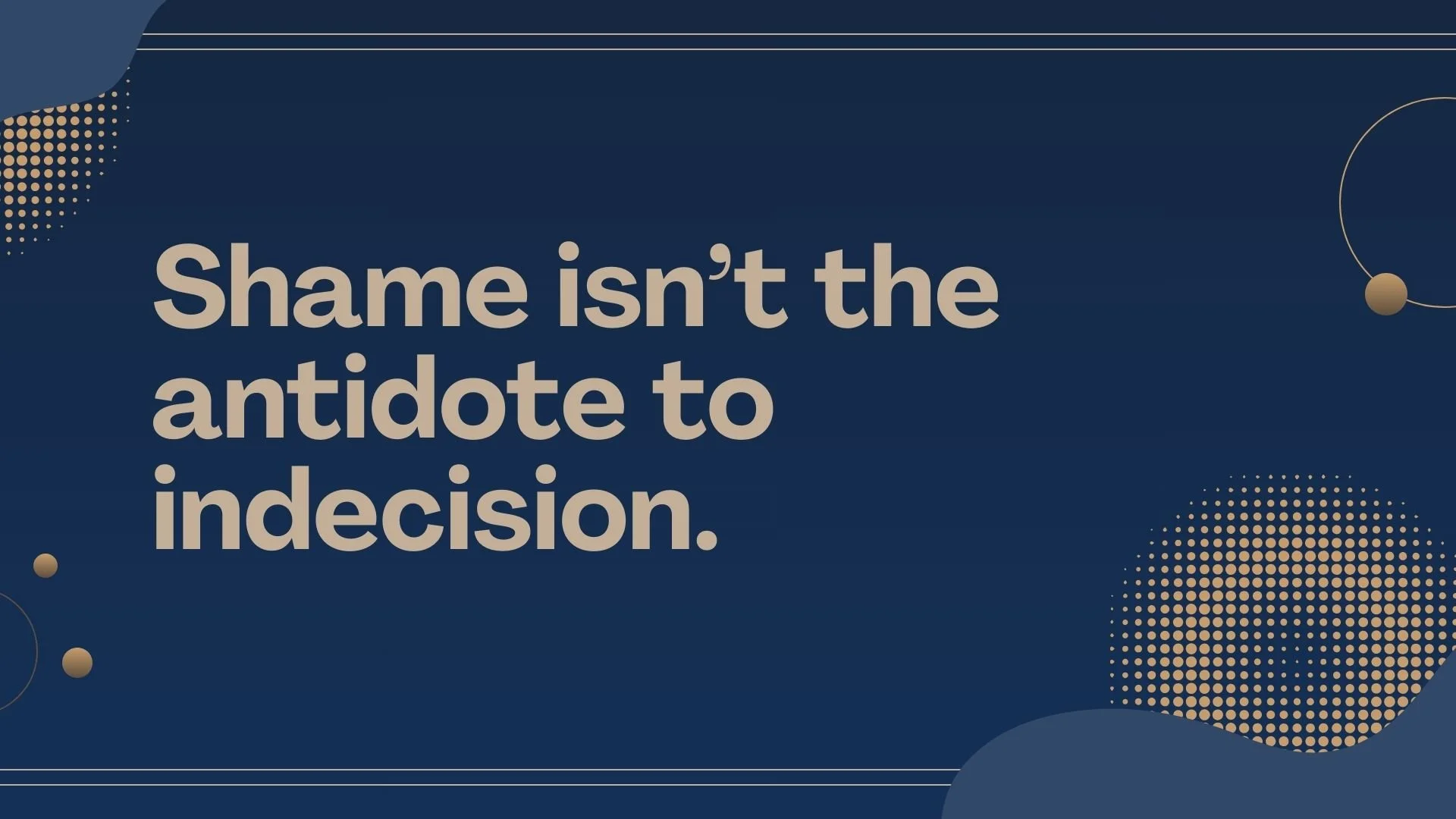
Shame isn’t the antidote to indecision.
Perfectionism
The perfectionism can lead to freezing and overwhelm. Other ways I’ve seen decision paralysis impact creative folks is having an inability to start a task or consider it complete. Their client or others may read this as apathy, missing the point, or a lack of discipline, but they are experiencing a self described obsession with details, which can be hard to understand from the outside.
Decision paralysis in it’s overwhelm, irritability, and in action can feel similar to anxiety and burnout. There is relief for these situations. Sometimes it requires counseling support to move past the freeze and overwhelm. I have also found some clients find it helpful to find situations outside of their professional responsibilities where there is structure, where they don’t have to make decisions, or where there are lower stakes. These can serve as reminders they are able to make decisions and introduce a different perspective.
Final thoughts
Establishing and building a business requires mental toughness and endurance. It can also be incredibly rewarding. My hope in writing this article is for entrepreneurs to not feel alone or shame in experiencing these pitfalls. They are often common for reasons beyond our control. They happen, they can be addressed, and there is hope for us. I wish you well on whatever business journey you are on, and for life outside of work. Let’s be kind to ourselves and each other.
If you’re curious about my counseling offerings, I can be reached by email.